History 150W-02: The Colonial & Revolutionary Tidewater
Email: jpwhit@wm.edu
Office: James Blair Hall 331
Web Page: http://faculty.wm.edu/jpwhit
Telephone: 757-221-3725
Office Hours: By Appointment
This isn't your typical class. For one thing, we meet on SATURDAYS
ONLY--and usually for the better part of the day. For another,
we will spend most of our classtime "on-site" at archaeological excavations,
museums, or inside standing (or ruined) historic buildings. The schedule
says the starting time is
I've always held discussions in this class over an extended lunch hour (comes from my association with archaeologists over the years). In my opinion, the food has added considerably to the fun of the course, and I'd like to retain the feature. We'll picnic much of the time. Well, pizza or sandwiches next to the York or the James isn't exactly onerous. Typically, I'll take orders for food by email and you can reimburse me. When we eat at restaurants (like the famous Surry House), I'll put the entire bill on a credit card and, again, you can reimburse me. Most of the time, I'll post a menu on the class website (click on "Food") several days before the trip.
Costs beyond the food might include computer supplies, photographic and supplies/services (optional), maybe some printing and photocopying. This is all "heap cheap," especially in view of....

Requirements & Grades: Students generally want to know every little thing about the grading system, but truth be known, it is all pretty-much a subjective process and in the end I evaluate the totality of your work over the course of the semester. Admittedly, many students find this ambiguity unsettling during the semester, but few seem to think the grades unfair in the end. Keep in mind that A grades are reserved for EXCEPTIONAL work, and to win an A for the course means hitting on just about all cylinders just about all of the time. The grade of B covers a much wider range of perfectly acceptable, even superior, performance. Any student who scrambles over all the course requirements and delivers even a modest effort should have no trouble attaining a C--acceptable, but undistinguished. To receive a final grade lower than C, a student in this class would simply have to stop trying. As I am incapable of higher mathematics, I have devised "the rule of quarters." Each component of the course will determine 25% (more-or-less) of your grade for the course:
I. Electronic Journal (25%):
The writing you do in this class will take the form of an electronic journal in which you will write a weekly entry that includes both text and images pertaining to our field trips, readings, and class discussions. NO COMPUTING EXPERTISE IS ANTICIPATED—I WILL TEACH YOU ABSOLUTELY EVERYTHING YOU NEED TO KNOW. You can check out some recent example of these electronic journals here. What you write is the key, and the greatest tool you have is the English language. It is the medium of William Shakespeare and Jane Austen; Rhys Isaac and Edmund Morgan. It is free to you for the taking. Don't abuse it.
I will assign you a very simple digital camera with which you will be able to record fieldtrips in a visual way and from which you may upload images to your on-line journal. You may use any of the images you take as “art” for your journal, but you can also use absolutely any images you can find on the internet. I'll give you plenty of help with that. You MUST post at least three images per fieldtrip. They can come from the internet, indeed from any source, as well as from the digital camera. And you may use your own digital or regular camera if you prefer. There is provision for identifying the source of the images as you place them in your journal.
The electronic journal must be complete by 5:00 on the Monday following the end of class (Monday, 5 December). Length is unimportant. Quality is everything. I will expect to see evidence of (1) a grasp of the major points in the readings, (2) critical evaluation of the meaning of the museums or historic sites in relationship to the themes expressed in the readings, (3) an understanding of the class discussions. Although this "electronic term paper" will be a work in progress without formal grades until I evaluate it as a whole at the end of the semester, I will look at it weekly and give you feedback from time to time.
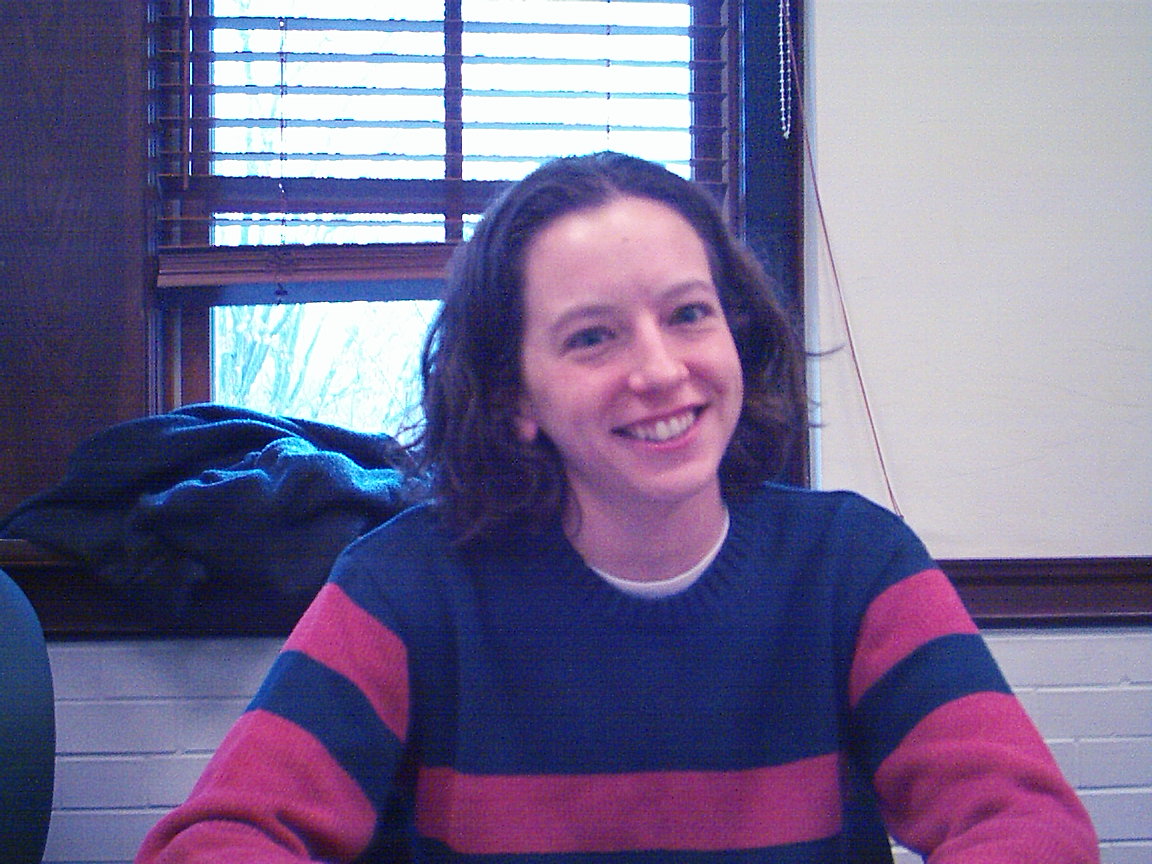
One our our first-year doctoral students, Sara Rebecca Lemmond,
 |
II. Oral Reports (25%):
Each of you will undertake two oral reports that stress the presentation of factual information linked in some way to the week's topic. The research should be easily accomplished from readily available material on the internet, in Swem Library or the Colonial Williamsburg Research Library (where you will be welcome, by the way, and where you will have borrowing privileges). I'll be happy to guide you to additional places to look. My purpose is to have you become familiar with a few of the most basic sources of factual information about early American History and to provide in your reports some “take off points” for class discussions. You'll get the topic assignments one week ahead of time. I'll expect you to email me an outline of the report by 5:00 pm on the Thursday prior to your time at center stage. I'll alert you if anything is amiss. These are to be SHORT reports--no more than 5 minutes--sometimes delivered before we depart, sometimes at lunch, sometimes in the middle of a site visit. Think of them this way: You are standing near the punch bowl at a party. Two or three people come up and demand that you explain your topic to them. In the space of consuming one glass of punch and two crackers loaded with Brie, what would you tell them?
III: Classtime Discussions (25%): As much of the discussion for any week will take place over lunch, we'll often do a lot of talking before we even see whatever it is we came to see after lunch, which in turn privileges the readings. Indeed, the only preparations I will expect is that you have a firm grasp of the readings. There will be also ample opportunity to talk as we poke around the places we visit and on the way home--place where we have an opening for an impromptu seminar session. Here again you are subject to my appallingly subjective evaluation of your participation in all class time activities. While I do care a great deal about attitude and attendance, I'm also willing to work around scheduling problems (like the schedule for the Women's Crew for several years running), but please talk to me early on.
IV: Final Exam (25%): The exam will consist of short-answer, even multiple choice, questions that will require you to know the readings and be able to relate them to the sites we'll visit and the discussions we'll have. We'll settle on a date late in the semester.
A Note on Guests: I'm delighted to accommodate requests for guests (roommates, siblings, and parents, for example)--to the extent of our available transportation. Do consult me ahead of time. Guests who can provide their own transportation are always welcome, even at the last minute.
Schedule
The schedule below is tentative,
but probably about right.
Background reading: These two chapters
from Alan Taylor's textbook on Colonial American might be useful to any
of you who feel you'd like a better background. They would probably be
interesting to everybody. BUT they are NOT required:
27
August: Outpost of Empire—What Really Happened at Jamestown?
Theme:
There are several competing explanations for the near-failure of Virginia
under the Company, 1607-1624. Some historians argue for poor management
by the Virginia Company. Recent archaeological excavations seem to undercut
that thesis, and even to cast doubt of the long-accepted notion that Jamestown
nearly failed. Certainly, however, the "starving time" was a reality. It
may be that environmental factors hold the key to understanding that bleak
period of Virginia history, or maybe it was the state of mind of the colonists.
Since we’re on “the island,” we’ll also jump ahead to the post-fort era when Jamestown became—for about 75 years—a true urban place—a city of surprising size and elegance, when compared to the first decade or so when the rough timber walls of the fort symbolized the place.
Sites:
Colonial
National Park: Jamestown Island
Readings:
3
September: Worlds Colliding
Theme:
Almost as soon as the English landed at Jamestown, they busied themselves
with finding a source of profit from the Virginia enterprise. After many
failed experiments and a all the while engaged in acontinuing bloody struggle
with Native Americans, the English hit upon tobacco, which required massive
amounts of both land and labor. For more than fifty years, white indentured
servants from England itself supplied labor for Virginia's tobacco fields,
but in one of the most fateful events in American history, 20 Africans
were sold into indentured servitude in Virginia by Dutch traders. By mid-century,
racial slavery was a fact in Virginia, and another half-century later,
slaves were the primary labor force. Sites: Jamestown
Settlement
Association
for the Preservation of Virginia Activities/Rediscovery Archaeology Project
Readings:
10 September: Founded Wholly on Smoke
Theme:
King James once remarked that Virginia was founded "wholly on smoke." By
that he meant he tobacco trade. The king might as well have included Virginia's
neighbor in the Chesapeake region, Maryland, which had actually been a
part of Virginia prior to 1632, when the King gave the triangle-shaped
colony to his friend, Cecil Calvert, later Lord Baltimore. Just as much
as Virginia, early Maryland was devoted to tobacco, and society there was
equally warped by the "sot-weed" trade. At St. Mary’s, we’ll find a recreated
tobacco farm from the second half of the seventeenth century, archaeology
sites, and most of a recreated town from the same era.
Sites: Historic St. Mary's City, Maryland
Readings:
17 September: Chaos & Stability at the End of the Seventeenth Century
Theme:
By the middle of the seventeenth century, a true gentry class had taken
shape in Virginia. It dominated political life and also the economy, and
it distinguished itself from the yeomanry and from servants through elements
of lifestyle such as the first grand plantation homes, of which only "Bacon's
Castle" survives. In large measure, the gentry rose to their exalted position
by exploiting the majority of Virginians—white indentured servants, whites
just emerging from the servant class, and the ever-increasing number of
African slaves. In 1676, discontent boiled over into Bacon's Rebellion.
The town of Williamsburg was at this point known as “Middle Plantation.”
We’ll visit the archaeological remnant of the largest house there—the John
Page mansion—and also tour the Wren Building, begun in 1695, a symbol of
the solidification of the power of the Virginia gentry.
As
an out-of-chronology extra, we’ll visit an 1850s slave house at Bacon’s
castle and try to come to grips with the survival of human slavery in Virginia
into the mid-nineteenth century.
Sites:
Bacon's
Castle
Readings:
24
September: Pride & Prejudice Theme:
Following Bacon's Rebellion in 1676, the great gentry families consolidated
their power in Virginia. They used marriage to create family alliances
that promoted a "super gentry" whose lifestyles set them quite apart from
almost everyone else. Beginning as early as 1720, their great power, wealth,
and access to massive amounts of slave labor allowed them to begin to build
homes that were unlike those of earlier Virginia in terms of size and quality.
Many a great family fortune was under great financial stress as a result
of individual--or family-wide--building campaigns. But "command" of a great
house was early-on a necessary component of being gentry. The great "river
plantations" like Shirley and Westover tell us much about the Georgian
Age of the Chesapeake. We’ll see two: Shirley and Westover, and discuss
the intertwined lives of the families there: the Carters and the Byrds. Sites:
Shirley
Plantation
Readings:
1
October: Church & State Theme: Theme:
Great Houses, Churches and Courthouses became the key features of the rural
landscape in eighteenth-century Sites:
Historic
Christ Church
Readings:
8
October: Fall Break!! 15
October: Buying Respectability Theme:
Consumer patterns among eighteenth-century Virginians both delineated class
lines and created a common culture on the eve of the Revolution. Social
status had long been associated with the ownership of the proper elements
of gentry lifestyles-from houses to dresses. As to have those items competition
increased across the eighteenth century, the rules--both of what one needed
to own and about how to use the items properly--seemed to change constantly.
And, of course, almost everything that one needed to possess came from
England and could be hand only in stores and shops such as those along
the Duke of Gloucester Street.
Sites:
DeWitt
Wallace Gallery
Readings:
22
October: People at the Margins
Theme:
Even as the Wythes and Randolphs enjoyed their place atop the social, political,
and economic pyramid of elite colonial society in Williamsburg, the bulk
of Virginia's people often lived lives the gentry would--and did--describe
as "mean." Not everyone was poor, of course, but half the inhabitants of
Williamsburg at the time of the Revolution were enslaved African Americans,
and other sorts of folk, both black and white, existed around the margins
of Georgian society. Some--notably the evangelical Baptists--seemed to
pose an outright threat to gentry dominance. Sites: George Wythe
House
Readings:
Shomer
Zwelling, Quest for a Cure: The Public Hospital in Williamsburg,
1773-1885 (1985), pp. 1-30.
23
October: OPTIONAL Barbeque at the Ruins of Rosewell, Sites: Ruins
of Rosewell Plantation Readings:
NONE Theme: A
favorite haunt of Thomas Jefferson, Rosewell was probably the most impressive
private home in British North America—three full stories with magnificent
details. The Page family seat, it was begun in 1725 century and survived
until 1916, when it burned. The ruins are spectacular in their own right—worthy
of Edgar Allen Poe. Each fall the Rosewell Foundation sponsors a barbecue
at the ruins. It is on a Sunday, inclues some fabulous food, gread live
music, and a silent auction. If you’d like to come with me, I’ll cover
the cost. 29
October: Power Plays
Theme:
By the 1770s, Williamsburg was both the seat of imperial authority and
the nexus of revolutionary activity in Virginia. The various public buildings
were the result of an extensive construction campaign that dated back to
the 1720s, but the meanings were transformed in the 1770s. Other buildings,
such as the Raleigh Tavern, took on political meaning as gatherings places
where the gentry talked about the relationship between colony and mother
country, and about the nature of government itself. But what of the majority?
What, for example, did the free yeoman of colonial America think and do? Sites:
Governor'
Palace
Readings:
Carl
Lounsbury, "Ornaments of Civic Aspiration: The Public Buildings of Williamsburg,"
in Robert P. Maccubbin & Martha Hamilton-Phillips, eds., Williamsburg,
Virginia, A City before the State: An Illustrated History (Williamsburg,
2000), pp.
Sites: Yorktown
Victory Center Theme:
How Revolutionary was the American Revolution? In Virginia, slavery tested
the limits of ideals such as liberty and freedom. African Americans played
a major role in pushing those conservative Virginians off the fence and
into the Revolutionary camp in 1775-1776. For the slaves themselves, the
conflict between England and the colonists opened intriguing questions
of where the best chance for freedom lay. Meanwhile, free Virginians continued
for another half-century to follow the lifestyles of colonial farmers.
Even relatively affluent farm families of the Revolutionary era—and the
Civil War era—had little to show in the way of consumer goods. Did their
world change in terms of political power as a result of the Revolution? Readings:
Theme:
Yorktown boasts some remarkable “survivors” from the Revolutionary era--like
the Nelson mansion and Grace Church--but we will need to create the remainder
of the town through imagination. One of the surviving buildings—the Ambler
store—should be a fine place to discuss Eliza Ambler and the changing status
of women as the eighteenth century closed. At the battlefield, we can evaluate
the “great battle” that resulted in independence. Sites:
Yorktown
Readings:
Donald
Rhinesmith, "October 1781: The Southern Campaign Ends at Yorktown," Virginia
Cavalcade, Vol. 31 (autumn1981), pp. 53-67.
Theme:
William & Mary's most famous alumnus, Thomas Jefferson, was a man of
contradictions that mirrored the contradictions in American life after
the Revolution. The quintessential advocate of liberty for white men, he
owned slaves his entire life, and unlike George Washington, he did not
free them even at his death. Jefferson's celebrated liaison with one of
those slaves, Sally Hemmings, complicates our interpretation of his legacy. Sites: Monticello
Readings:
Tour
of the Wren Building & the Historic Campus with members of the Spotswood
Society
The
John Page House
Westover
Plantation
King
William County Courthouse
Stores
and Shops Along the Duke of Gloucester Street
Peyton
Randolph House
Public
Hospital
The
Powder Magazine
Public
Goal
Bruton
Church
House
of Burgess
Courthouse
Raleigh
Tavern
25-38.
Colonial
National Park: Yorktown Battlefield
19
November: The Alumnus: Montocello
Return
to the Main Page for this Class
Return
to JPW's Homepage